How Companies Lose Money Through Poor Processes | Diligen Business Solutions
How Companies Lose Money Through Poor Processes – And How Diligen Helps Businesses Improve Efficiency
In today’s fast-changing business environment, companies constantly focus on increasing sales and expanding operations. However, many organizations fail to notice one major issue quietly affecting their profits, poor business processes. While revenue generation is important, inefficient workflows, outdated systems, and communication gaps can slowly drain a company’s finances over time.
This is where companies like Diligen can play a crucial role by helping businesses streamline operations, improve efficiency, and reduce unnecessary losses through smarter process management.
In this blog, let’s explore how poor processes cost businesses money and why improving operational efficiency is essential for long-term success.
What Are Poor Business Processes?
To begin with, business processes are the structured methods companies use to complete tasks and achieve goals. These processes include operations such as customer support, sales management, project handling, employee onboarding, inventory tracking, and financial reporting.
However, when these systems become outdated, confusing, or unnecessarily complicated, businesses start experiencing operational inefficiencies. As a result, productivity decreases, employee frustration increases, and financial losses become unavoidable.
Fortunately, modern business solution providers like Diligen help organizations identify workflow bottlenecks and optimize operations for better performance.
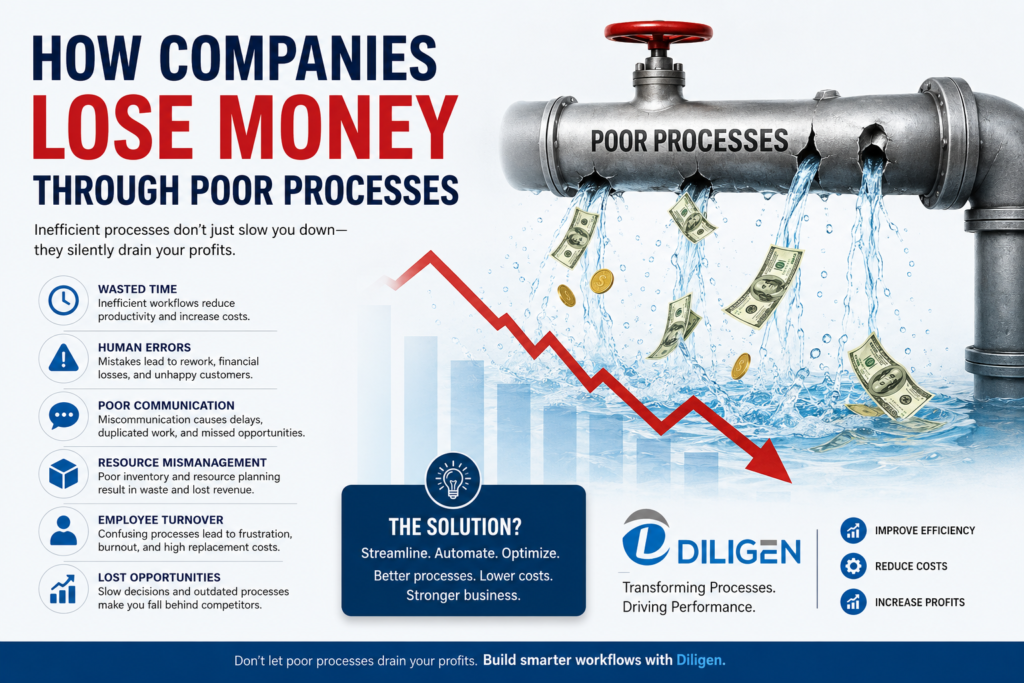
1. Wasted Employee Time Reduces Profitability
One of the biggest ways companies lose money is through wasted employee time. In many organizations, workers spend hours handling repetitive manual tasks that could easily be automated.
For example:
- Manual data entry
- Repeated approval processes
- Poor task coordination
- Searching for missing information
Consequently, teams spend more time managing processes instead of focusing on productivity and innovation.
Moreover, when multiple departments experience delays, operational costs increase significantly. Therefore, businesses that fail to optimize workflows often struggle to maximize profits.
By implementing efficient operational strategies with support from companies like Diligen, businesses can improve productivity while reducing unnecessary workload.
2. Human Errors Create Expensive Problems
Another major issue caused by poor processes is the increase in human errors. When systems lack clarity or proper structure, mistakes become more frequent.
For instance:
- Incorrect invoices may be generated
- Orders can be processed inaccurately
- Customer information may be mishandled
- Financial calculations could become inconsistent
As a result, companies spend additional time and money correcting these mistakes. Furthermore, repeated errors can damage customer trust and harm brand reputation.
This is why process optimization and workflow standardization are essential for sustainable business growth.
3. Poor Communication Slows Business Growth
In addition, weak internal communication is one of the most common causes of operational inefficiency. When employees rely on scattered communication systems or unclear instructions, misunderstandings become inevitable.
Consequently:
- Projects face delays
- Tasks get duplicated
- Teams lose coordination
- Important updates are missed
Over time, poor communication affects customer service, employee productivity, and overall business performance.
To address these challenges, organizations increasingly rely on business efficiency solutions from platforms like Diligen to create streamlined workflows and better collaboration systems.
4. Inefficient Technology Usage Wastes Company Resources
Today, many businesses invest heavily in digital tools and software. However, purchasing technology alone does not guarantee efficiency.
In many cases, companies fail to properly integrate software into daily operations. As a result, employees continue using outdated manual methods alongside modern systems.
Consequently:
- Work gets duplicated
- Software investments go underutilized
- Productivity improvements remain limited
Therefore, businesses must ensure that technology and operational processes work together effectively.
With the right digital transformation strategies, companies can reduce operational costs and improve overall efficiency.
5. Inventory and Resource Mismanagement Causes Financial Losses
For retail, manufacturing, and product-based businesses, inventory management plays a critical role in profitability. Unfortunately, poor inventory processes often result in unnecessary expenses.
For example:
- Overstocking increases storage costs
- Understocking causes missed sales opportunities
- Poor tracking leads to damaged or expired products
As a result, businesses lose revenue while also increasing operational waste.
By improving workflow systems and operational planning, organizations can avoid these costly inventory issues and maintain healthier profit margins.
6. Employee Burnout Increases Turnover Costs
Another hidden impact of poor business processes is employee dissatisfaction. When workflows are disorganized and employees constantly face operational confusion, stress levels naturally increase.
Consequently:
- Productivity declines
- Employee morale decreases
- Staff turnover increases
Furthermore, hiring and training new employees requires significant time and money.
Therefore, businesses that prioritize process improvement often experience better employee retention and stronger workplace performance.
Companies focused on operational excellence, including Diligen, understand the importance of building systems that support both efficiency and employee satisfaction.
7. Slow Decision-Making Leads to Missed Opportunities
In modern markets, speed matters more than ever. However, companies with inefficient approval systems and unclear management structures often struggle to make timely decisions.
As a result:
- Business opportunities are missed
- Competitors move faster
- Customer expectations are not met
Ultimately, slow decision-making can directly impact company growth and revenue generation.
This is why businesses increasingly invest in process optimization strategies to improve responsiveness and operational agility.
8. Poor Customer Experience Damages Brand Reputation
Customer satisfaction is directly connected to internal business processes. If workflows are inefficient, customers eventually notice the consequences.
For example:
- Delayed support responses
- Slow delivery times
- Billing issues
- Inconsistent service quality
Consequently, customers may choose competitors instead. Additionally, negative reviews can damage the company’s online reputation.
Therefore, improving operational systems is not just about saving money, it is also about protecting customer trust and long-term brand value.
How Businesses Can Improve Poor Processes
Fortunately, businesses can reduce inefficiencies and improve profitability through continuous process improvement.
Here are some effective strategies:
1. Analyze Existing Workflows
Identify bottlenecks, repetitive tasks, and unnecessary operational steps.
2. Automate Repetitive Processes
Use modern automation tools to reduce manual work and improve accuracy.
3. Improve Communication Systems
Centralized communication platforms help teams stay aligned and productive.
4. Train Employees Effectively
Employees perform better when they fully understand systems and workflows.
5. Partner With Operational Efficiency Experts
Working with companies like Diligen can help organizations improve workflow efficiency, optimize business operations, and reduce long-term operational costs.
Final Thoughts
To conclude, companies rarely lose money because of one major mistake. Instead, they often lose profits gradually through poor processes, inefficient workflows, communication gaps, and outdated operational systems.
However, businesses that focus on operational excellence can significantly improve productivity, reduce costs, and strengthen customer satisfaction. By adopting smarter business strategies and leveraging modern workflow solutions from providers like Diligen, organizations can build stronger foundations for long-term growth and success.
In today’s competitive market, improving processes is no longer optional, it is essential for sustainable business performance.